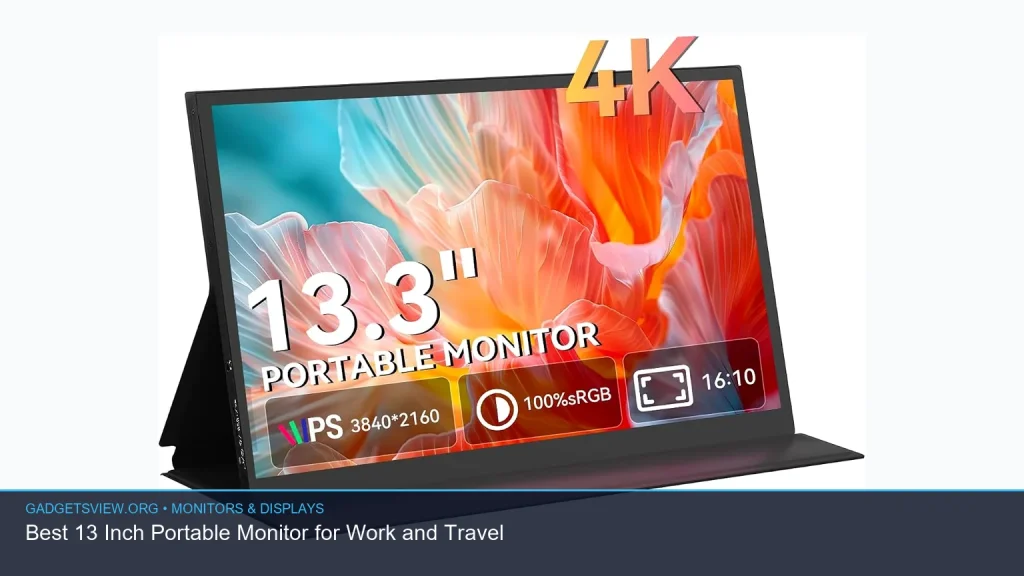
If you need a second screen that fits in a bag, a 13 inch portable monitor is one of the best sizes to consider. It is large enough for real work, yet small enough for travel, coffee shops, and tight desks. The best choice depends on how you work: some buyers should prioritize sharp text and color accuracy, while others will value touch support, lighter weight, or a better panel for media. This guide breaks down what to look for and helps you choose the right option for work and travel.
📖 Table of Contents
Products mentioned
- 13.3 Inch Portable Monitor 3840×2160 IPS Display 100% sRGB
View current product details - 13.3-Inch OLED Portable Monitor Touchscreen, 1080P HDR 500-Nit Display
View current product details
Availability, specifications, and prices can change; verify them on the product page.
📌 Key Takeaways
- A 13-inch portable monitor is a strong balance of screen space, portability, and desk comfort.
- Choose a display based on your main use case: sharp text for work, touch for flexibility, or OLED for richer contrast.
- Check connection needs first. USB-C with video support is often the simplest setup, but not every laptop can use it the same way.
- For commercial intent, the best pick is the one that matches your workflow, not the one with the longest feature list.
Why a 13 Inch Portable Monitor Makes Sense
The 13 inch portable monitor has become a sweet spot for people who work away from a full desk. It is compact enough to carry in a laptop bag, but still useful for split-screen work, spreadsheets, documents, email, and side-by-side browsing. If you use a 13-inch laptop, adding a second screen can make a big difference without feeling bulky.
This size also works well for travel. It is easier to set up in hotels, shared workspaces, and client sites than larger monitors. For many users, the main goal is not maximum screen size. It is a screen that is easy to bring along and quick to use.
What to Look for in a 13 Inch Portable Monitor
The right portable monitor should match your laptop, your workload, and your travel habits. A screen that looks great in a product listing may still be a poor fit if it needs too much power, lacks the right ports, or feels awkward to carry.
Display quality
For office work, focus on text clarity, viewing angles, and brightness. If you edit photos, create content, or watch a lot of video, color coverage and contrast matter more. Product listings in your research show two clear directions: a 13.3-inch portable monitor with 3840×2160 resolution and 100% sRGB, and a 13.3-inch OLED portable monitor touchscreen with 1080p HDR and 500 nits. Those names suggest different priorities, but actual performance should still be confirmed with current product details.
Connectivity
USB-C is the easiest option when it supports both power and video from your laptop. Some models may also include mini HDMI for broader compatibility. Before buying, confirm that your device can output video over USB-C, because not every USB-C port can do that.
Portability and build
Travel-friendly monitors should be thin, protected, and simple to pack. A folio-style stand or protective cover can be useful, since the stand often doubles as a travel case. If you move between locations often, small design details like cable routing and stand stability matter more than spec sheets.
Power needs
Some portable monitors can run from your laptop, while others may need extra power. This is especially important if you work from a phone, tablet, or older laptop. Fewer cables usually means a better travel setup, so check whether one cable is enough for your use case.
How the Main Types Compare
Not every 13-inch portable monitor serves the same buyer. Some are made for productivity, while others lean toward premium visuals or touch interaction. Use the comparison below to narrow your choices quickly.
| Monitor type | Best for | Strengths | Limitations |
|---|---|---|---|
| 13.3-inch 4K IPS portable monitor | Text work, spreadsheets, detail-heavy tasks | Very sharp image, wide viewing angles, good for productivity | May cost more, and 4K can be overkill for simple use |
| 13.3-inch OLED touchscreen portable monitor | Media, creative work, touch-friendly workflows | Strong contrast, rich colors, touch control | Touch may add complexity, and 1080p is less sharp than 4K |
Best Use Cases: Which Buyer Should Choose What?
The best 13-inch portable monitor depends on what you do most. A traveler who mainly answers email has different needs than a designer who edits images or a remote worker who lives in spreadsheets. The goal is to match features to your daily workflow.
Choose a 4K IPS model if…
You want crisp text, clean side-by-side windows, and a display that feels close to a desktop monitor in clarity. This is the better path for writers, analysts, developers, and anyone who spends long hours reading documents. If the listed 13.3 Inch Portable Monitor 3840×2160 IPS Display 100% sRGB is still under review, verify the final spec sheet before buying.
Choose an OLED touchscreen model if…
You care most about contrast, richer color, and touch interaction. An OLED panel can be appealing for presentations, streaming, and creative tasks where image quality matters. The 13.3-Inch OLED Portable Monitor Touchscreen, 1080P HDR 500-Nit Display suggests a more premium visual experience, but you should still confirm brightness, touch support, and HDR behavior on the final retail listing.
Choose neither if…
You mainly need the cheapest possible secondary display and do not care much about resolution, touch, or color quality. In that case, a simpler portable monitor may be enough. Still, make sure the panel is easy to carry and compatible with your laptop, or the savings may not be worth the tradeoff.
Selection Criteria for Work and Travel
If you are buying for business use or frequent travel, focus on practical details first. A great screen that is awkward to power or carry can become a burden fast. Use this shortlist to compare models in a more disciplined way.
- Compatibility: Confirm USB-C video support or mini HDMI support for your laptop.
- Resolution: Higher resolution helps with text and multitasking, especially on a 13-inch panel.
- Panel type: IPS is usually a safe choice for work; OLED often wins on contrast.
- Touch support: Useful for presentations and some workflows, but not essential for everyone.
- Brightness: Important if you work in bright rooms, cafes, or near windows.
- Stand and case: A sturdy cover stand can improve stability during travel.
- Weight and thickness: Small differences matter if you pack the monitor every day.
Common Limitations to Watch For
Portable monitors can look simple, but small details often decide whether they are pleasant to use. Before you buy, pay attention to the limits that can affect daily workflow. These are the issues most likely to cause regret later.
First, some laptops cannot deliver video and power over a single USB-C cable. That means you may need a second cable or an external power source. Second, some 13-inch displays feel cramped if you keep many windows open, so a higher resolution helps a lot.
Third, touchscreens can be handy, but they are not always needed for laptop use. Fourth, OLED displays may look excellent, but they are not automatically the best choice for everyone. If your work is mostly text, a sharp IPS monitor may be the more practical option.
Quick Decision Guide
If you want a fast answer, this simple guide can help you decide. Start with your main priority, then narrow your choice from there.
| Your priority | Best direction |
|---|---|
| Sharp text and multitasking | 4K IPS portable monitor |
| Better contrast and media viewing | OLED portable monitor |
| Touch control and flexibility | Touchscreen portable monitor |
| Simple travel setup | Lightweight monitor with USB-C and a built-in stand |
FAQ
Is a 13 inch portable monitor big enough for work?
Yes, for many people it is. It is especially useful as a second screen for email, chat, research, documents, and side-by-side viewing. If you need lots of open windows at once, a higher resolution can help make the size feel more usable.
Should I choose 4K or 1080p for a 13-inch screen?
For text-heavy work, 4K usually offers a sharper feel. For casual use, travel, and media viewing, 1080p may be enough. The best choice depends on how much clarity you need versus how much value you place on simplicity and cost.
Does a portable monitor work with any laptop?
Not always. Many work well with laptops that support USB-C video output or mini HDMI, but you should check your device first. The monitor and laptop must share a compatible connection method.
Are touchscreen portable monitors worth it?
They can be worth it if you use touch input often, present to clients, or want extra flexibility. If you mainly type and click, touch may be a nice extra rather than a must-have.
What should I verify before buying?
Check resolution, port compatibility, power needs, stand design, and whether your laptop supports the needed video output. If a listing makes strong claims, confirm the current product page and manual before purchase.
Final Verdict: Who Should Choose What
If your goal is productivity, a 13 inch portable monitor with a sharp IPS panel is often the safest choice. If you want richer visuals and touch flexibility, an OLED touchscreen model may fit better. The best pick is not the one with the most features. It is the one that fits your laptop, your travel habits, and the way you actually work.
Before you buy, confirm connection support, power requirements, and the final published specifications. Then choose the model that gives you the best balance of portability, clarity, and ease of use for your daily setup.