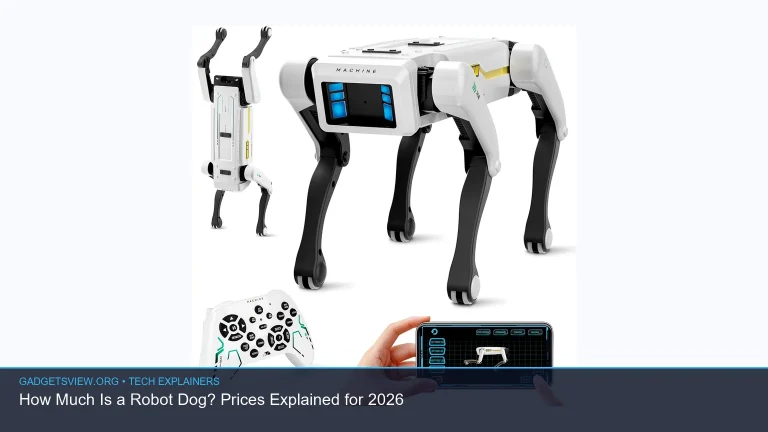
An electric dog is not a real pet. It is a robot that walks on four legs and often looks and moves a lot like an animal. Most people use the term to mean a quadrupedal robot, a machine built to balance, walk, sense its surroundings, and perform tasks that are hard or risky for people. In this guide, you’ll learn how an electric dog works, where it is used, and why it matters for security, industry, and the future of robotics.
📖 Table of Contents
📌 Key Takeaways
- An electric dog is a four-legged robot designed to move with balance and flexibility.
- It uses sensors, motors, software, and control systems to walk, stop, turn, and avoid obstacles.
- These robots can support inspection, research, security, and emergency response.
- The main value is not novelty. It is access to places and tasks that are too dangerous, narrow, or repetitive for people.
What Is an Electric Dog?
An electric dog is a robotic machine shaped like a dog or another four-legged animal. It is usually powered by batteries and controlled by onboard computers. The goal is to move across real-world surfaces in a way that is more stable than a wheeled robot and more flexible than a drone.
People may also call it a robot guard dog when it is used for patrol or security. That name can be misleading, though. It does not think like a pet or guard animal. It follows software instructions, sensor data, and human control rules.
These robots can look advanced, but the basic idea is simple: copy the advantages of an animal’s body while replacing instincts with code. That blend is what makes the electric dog such an important robotics platform.
How an Electric Dog Works

An electric dog works by combining hardware, sensors, and software into one coordinated system. Each leg has joints powered by electric motors or actuators. Those joints move in small, controlled steps so the robot can stand, walk, climb, or recover balance.
The robot’s brain is a set of processors and control algorithms. These systems decide how much force each leg should use, when to shift weight, and how to stay upright. In simple terms, the robot is always calculating where its body is, where the ground is, and how to move next.
Core parts inside a quadrupedal robot
- Motors or actuators: Move the legs and joints.
- Sensors: Measure position, speed, tilt, distance, and sometimes heat or sound.
- Control software: Turns sensor data into movement commands.
- Battery system: Supplies power to the robot.
- Onboard computer: Processes data and runs navigation or task software.
Many systems also include cameras, lidar, depth sensors, or microphones. These tools help the robot understand its surroundings. Some models can map a room, spot obstacles, or stream live video to a remote operator.
Why Four Legs Matter
Four legs give the robot a major advantage on uneven ground. Wheels are efficient on flat surfaces, but they struggle with stairs, rubble, curbs, and rough terrain. A robot dog can step over gaps, adjust to slopes, and keep moving when the path is imperfect.
This matters in real environments. Warehouses, construction sites, utility corridors, and disaster zones are often full of obstacles. A quadrupedal robot can move through many of these spaces with more freedom than a wheeled machine.
That said, four legs do not make the robot perfect. Walking uses a lot of energy, and balance control is complex. The tradeoff is clear: more mobility, but also more engineering and more power demand.
Where Electric Dogs Are Used
Electric dogs are not just science projects. They are used in areas where repeated checks, remote sensing, or risky travel matter. The exact role depends on the robot’s sensors, software, and operator control.
One common use is inspection. A robot can move through industrial areas, take camera readings, and help identify problems without sending a person into a dangerous space. It can also support research by testing how robots handle different terrain and movement tasks.
Security is another area of interest. A robot guard dog may patrol a site, record video, or alert staff to movement. In that setting, its value comes from coverage and persistence, not from acting like a living animal.
Typical use cases
- Factory and warehouse inspection
- Construction site monitoring
- Utility and infrastructure checks
- Research and robotics testing
- Public safety and emergency scouting
In emergency settings, an electric dog can enter unstable or dirty areas before people do. It may help responders see hazards, locate blocked paths, or assess damage. That can save time and reduce risk.
Electric Dog vs. Other Robots
Not every robot is built for the same job. A wheeled robot is often simpler and more energy efficient. A drone can fly over obstacles. An electric dog sits in the middle and offers a balance of mobility, control, and ground access.
Choosing between them depends on the environment. If the path is smooth, wheels are often better. If the robot must see from above, a drone may work best. If it needs to move on stairs, rubble, or uneven floors, a quadrupedal robot often makes more sense.
| Robot Type | Strengths | Limitations | Best Fit |
|---|---|---|---|
| Electric dog | Handles rough ground, steps, and obstacles | More complex, often slower, uses more power | Inspection, security, rescue scouting |
| Wheeled robot | Simple, efficient, stable on flat surfaces | Struggles with stairs and rough terrain | Indoor delivery, factory floors, clean paths |
| Drone | Fast overhead view, can bypass ground obstacles | Limited flight time, airspace and safety issues | Aerial inspection, mapping, rapid survey |
Who should choose what? If the job is on flat indoor floors, wheels are usually the smart choice. If the job is in the air, a drone fits better. If the job needs ground mobility across mixed terrain, the electric dog is often the strongest option.
Why Electric Dogs Matter
The real importance of an electric dog is not the novelty of a robot that looks like a pet. It is the way this design expands what robots can do in the physical world. Four-legged movement gives machines a way to go where human access is hard or unsafe.
That matters for safety. A robot can enter a damaged structure, noisy plant, or hazardous zone and collect information first. It may reduce exposure to heat, dust, chemicals, or unstable ground.
It also matters for efficiency. Repetitive patrols and inspections take time and human effort. A robot can handle routine tasks while staff focus on judgment-based work. That makes the system a tool for support, not a replacement for human oversight.
How to Evaluate an Electric Dog System
If you are trying to understand or compare electric dog systems, focus on function rather than the brand name. A good robot is the one that fits the job, the site, and the control setup.
Use the checklist below to judge whether a system is practical for a specific use case.
- Check terrain needs: Will it need to handle stairs, slopes, gravel, or indoor floors?
- Review sensor package: Does it need cameras, lidar, thermal tools, or only basic navigation?
- Look at control mode: Is it autonomous, remote-controlled, or a mix of both?
- Consider battery life: Longer tasks need better power management and charging plans.
- Think about safety: Will it work near people, vehicles, or sensitive equipment?
- Match the task: Patrol, inspection, mapping, and research all need different robot behavior.
It is also wise to verify vendor claims against current documentation. If a robot is meant for real deployment, ask for the latest safety guidance, maintenance plan, and operating limits. Those details matter more than flashy demos.
Common Limits and Challenges
Electric dogs are impressive, but they are not magic. They can struggle with loose surfaces, deep water, slippery floors, or clutter that blocks leg movement. Even advanced systems may need careful path planning.
Battery life is another constraint. Four-legged motion takes energy, and the robot may need frequent charging or battery swaps for long shifts. Noise, cost, and software complexity can also be barriers.
There is also the human factor. A robot guard dog should not be treated like a security decision-maker. It is a sensing and mobility tool. People still need to review alerts, make judgments, and handle response planning.
FAQ
Is an electric dog the same as a robot dog?
Yes, in most casual use, the terms mean the same thing. “Electric dog” is a broad, informal way to describe a robotic four-legged machine. “Robot dog” is the more common name.
What makes a quadrupedal robot different from a humanoid robot?
A quadrupedal robot uses four legs for balance and movement. A humanoid robot is shaped more like a person, with two legs and sometimes arms. The quadrupedal design often works better on rough or unstable ground.
Can a robot guard dog replace human security staff?
No. It can support patrols and monitoring, but it cannot replace human judgment, response, or decision-making. It is best used as a tool that extends coverage and helps gather information.
Are electric dogs useful in homes?
They can be, but most home use is limited compared with industrial or research settings. A home environment may not justify the cost or complexity unless there is a specific need, such as remote monitoring or robotics testing.
Why not just use drones instead?
Drones are excellent for aerial views, but they do not work well when they need to land, climb, or stay on the ground for close inspection. An electric dog is better when the task requires controlled movement across rough terrain.
Conclusion
An electric dog is a practical robotics platform built for movement, sensing, and task support on difficult ground. It matters because it can go places that are hard for people and other machines to reach. That makes it useful for inspection, security, research, and emergency work.
If you want to understand one thing, make it this: the value of an electric dog is not how much it looks like a pet. It is how well it solves real-world access problems. As robotics improves, that role is likely to grow.