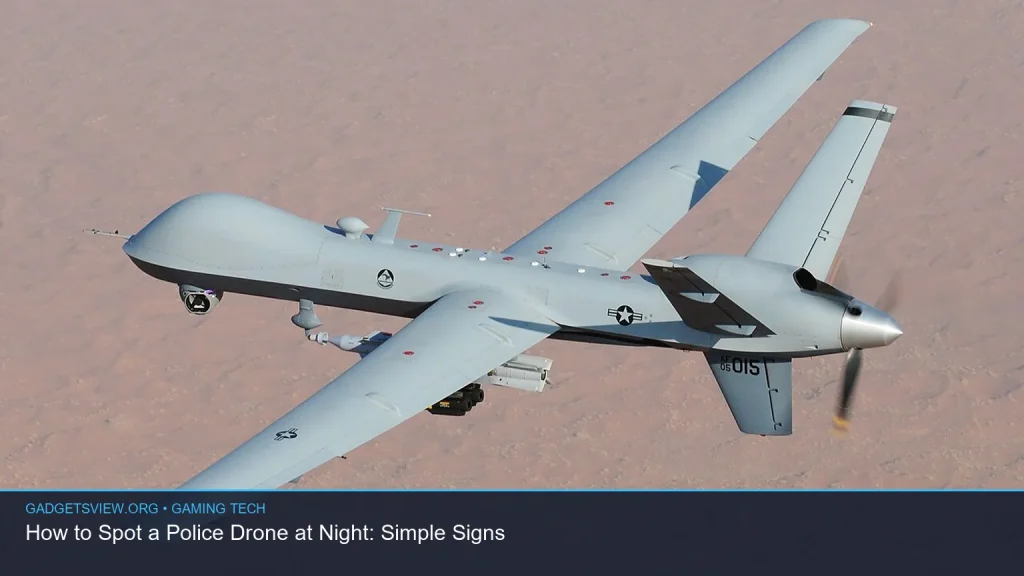
If you’re trying to figure out how to spot a police drone at night, the best clues are usually simple: bright navigation lights, a steady hovering pattern, and purposeful movement over a specific area. Police drones often look different from hobby drones because they may stay in one place longer, sweep a location methodically, or track a person or vehicle. In this guide, you’ll learn the most reliable signs, what can confuse you, and how to react safely without jumping to conclusions.
📖 Table of Contents
- What Makes a Police Drone Easier to Notice at Night?
- How to Spot a Police Drone at Night: The Most Common Signs
- Steps to Check Whether It Is Actually a Police Drone
- Common Things That Can Look Like a Police Drone
- What to Do If You Think a Police Drone Is Watching You
- Quick Troubleshooting Guide: Is It a Police Drone or Not?
- Limits of What You Can Tell From the Ground
- FAQ
- Conclusion
📌 Key Takeaways
- Police drones at night are often easiest to spot by their lights, sound, and steady hover patterns.
- A drone circling one spot, following a road, or holding position above an incident is more likely to be official than casual.
- Do not assume every drone is law enforcement; many private and hobby drones use similar lights and flight behavior.
- If you think a drone is monitoring you, stay calm, move to a well-lit public area, and contact local authorities if needed.
What Makes a Police Drone Easier to Notice at Night?
Night makes drones harder to see, but it also makes their signs stand out more. Lights, motion, and sound become the main clues when the airframe itself is invisible. If you know what to look for, you can often tell the difference between a random drone and one that is being used for public safety work.
Police drones are usually sent to observe an area, support officers on the ground, or search for a person or object. That mission often creates a more controlled flight path than a hobby drone would have. The drone may hover in place, move in straight lines, or return to the same area again and again.
How to Spot a Police Drone at Night: The Most Common Signs
Start with the easiest clues first. One sign by itself is not enough, but several together can point toward a police drone. The more of these you notice, the stronger the case.
1. Bright navigation or status lights
Many drones use small LEDs that may flash, blink, or stay on steadily. At night, these lights can appear as red, green, white, or a mix of colors depending on the model and the operator’s settings. A police drone may also have lights that are easier to see because it is flying at a height where the glow stands out against the dark sky.
2. Steady hovering over one area
One of the clearest signs is a drone that seems to stay in place for long stretches. Public safety drones often hover while an operator watches a scene, checks for movement, or helps guide officers. A hobby drone usually moves more freely or changes direction in a less deliberate way.
3. Purposeful scanning patterns
Look for slow side-to-side sweeps, repeated loops, or movement along a road, parking lot, or neighborhood block. These patterns can suggest a search or surveillance task. If the drone keeps returning to the same place, that can be a strong clue that it is being used for an official purpose.
4. A distinct buzzing sound
Some drones make a clear buzzing or humming noise, especially when they are close. At night, sound may carry farther because the background is quieter. If you hear a drone and then see lights moving in a controlled way overhead, that combination can help confirm what you are seeing.
5. Positioning near an active event
Police drones are often used near traffic stops, searches, missing-person cases, or emergency scenes. If the drone stays above a closed street, a cordoned area, or a location where officers are active, it is more likely to be law enforcement related. Still, you should avoid assumptions unless you can confirm the source.
Steps to Check Whether It Is Actually a Police Drone
If you want to verify what you are seeing, use a calm step-by-step approach. This helps you avoid panic and reduces the chance of misidentifying a private drone. It also keeps you focused on observable facts instead of guesses.
- Look for the light pattern. Note the color, brightness, and whether the lights blink or stay on.
- Watch the flight path. See whether the drone hovers, circles, or moves in a straight line over a specific place.
- Listen for sound. A strong buzzing sound can help confirm that the object is a drone rather than a plane or helicopter.
- Check the setting. Nearby officers, blocked streets, emergency vehicles, or an active search increase the chance it is official.
- Use local context. Some departments announce drone use during searches or emergencies. If it feels safe, check local alerts or official social media after the fact.
Do not try to chase the drone with your own device or move closer just to inspect it. Night conditions make depth and distance hard to judge, and that can create risk. If you are in doubt, stay where you are and observe from a safe place.
Common Things That Can Look Like a Police Drone

Misidentification is common at night. Several airborne objects can look similar from far away, especially if you only catch a small light in the sky. Knowing the differences can save you from drawing the wrong conclusion.
| Object | What It Often Looks Like | Main Difference |
|---|---|---|
| Hobby drone | Small lights, quick turns, informal movement | Usually less methodical and not tied to an active scene |
| Helicopter | Louder, larger light cluster, slower to change direction | Much noisier and typically higher than a small drone |
| Airplane | Distant lights moving steadily across the sky | Does not hover in place |
| Streetlight or reflection | Static glow or repeated flashes | No real flight movement |
Who should choose what? If you see a light that moves and hovers, treat it like a drone until proven otherwise. If the light moves steadily across the sky without stopping, it is more likely to be a plane. If you hear a strong rotor sound and see slow, deliberate motion near an incident, the chance of a police drone increases.
What to Do If You Think a Police Drone Is Watching You
Your first job is to stay calm. A drone overhead does not automatically mean you are being targeted, and jumping to conclusions can lead to mistakes. Focus on safety and simple, legal steps.
- Move to a safe, well-lit place. Stay near other people if you can.
- Avoid sudden gestures. Do not wave objects at the drone or try to shine bright lights into it.
- Do not interfere. Never throw anything, point lasers, or try to disable the drone.
- Document details from a distance. If needed, note the time, location, light pattern, and direction of travel.
- Contact authorities if there is a safety concern. If the drone is near an emergency or you believe there is a threat, call local law enforcement or emergency services.
If you feel uncomfortable, remember that many police drone flights are tied to public safety work rather than personal monitoring. The best response is calm observation and, if needed, a report through normal channels. Avoid posting guesses online as fact unless you have confirmation.
Quick Troubleshooting Guide: Is It a Police Drone or Not?
Use this table if you are trying to make sense of what you see. It can help you move from “maybe” to a more informed judgment. The goal is not perfect certainty, but a practical decision based on visible clues.
| What You Observe | Likely Meaning | Best Next Step |
|---|---|---|
| Small blinking lights with quick movement | Could be a hobby drone | Watch for hover patterns and nearby activity |
| Hovering above one place for a long time | May be a public safety drone | Check for officers, emergency vehicles, or a search area |
| Loud rotor noise and large light cluster | More likely a helicopter | Look for aircraft shape and higher altitude |
| Single static light that does not move | Probably not a drone | Check if it is a streetlight, sign, or reflection |
Limits of What You Can Tell From the Ground
At night, distance changes everything. A small drone far away can look like a bright dot, while a drone close up may be easy to hear but hard to identify by shape. Weather, trees, building lights, and background noise can all distort what you think you see.
That is why it is wise to treat any nighttime sighting as a clue, not a final answer. Even if a drone seems official, you may not be able to confirm it without local context or an announcement from the department. When verification matters, check official sources rather than guessing.
FAQ
Can I tell if a drone belongs to police just by its lights?
Not always. Lights can suggest a drone, but they do not prove ownership. Many drones use similar blinking lights, so you need to combine the light pattern with flight behavior and nearby activity.
Do police drones always hover in one place?
No. Some hover, but others move in patterns, follow a search route, or track a road. Hovering is common because it gives the operator a stable view, but it is not the only sign.
Are police drones louder than regular drones?
Not necessarily. Sound depends on size, distance, and the environment. A close hobby drone can sound louder than a police drone far away, so sound alone is not enough to identify it.
What should I do if a drone is near my home at night?
Stay calm, avoid interfering, and note the time and behavior. If there is an obvious safety issue or active emergency, contact local authorities. If you are simply curious, check local news or official public safety channels later.
Is it legal to film a drone from my property?
In many situations, yes, but laws can vary by location and by what you do with the recording. Do not harass the operator or try to block the drone. If you have privacy concerns, consider speaking with local authorities or a legal professional.
Conclusion
To spot a police drone at night, look for a mix of signs: steady lights, careful hovering, deliberate scanning, and activity near an incident. The key is to compare what you see against other possibilities before deciding. If you stay calm and use the steps above, you can make a smarter call without overreacting.
Next time you notice an unusual light in the sky, start with observation, not assumption. Check the pattern, note the setting, and use official sources when you need confirmation.