
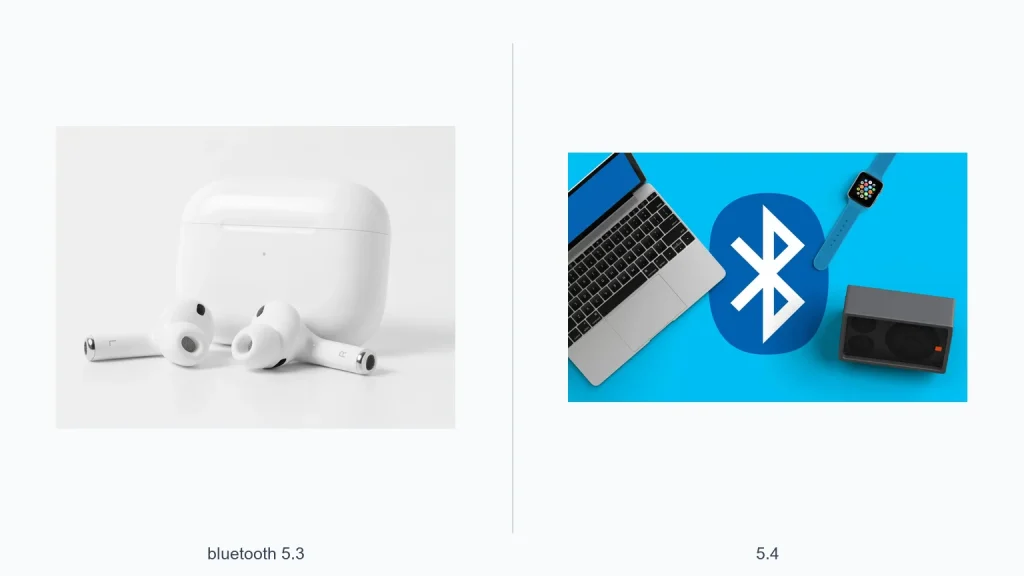
Trying to decide between bluetooth 5.3 vs 5.4? The short answer is that both are solid, modern Bluetooth versions, but 5.4 adds a few smart upgrades for reliability, efficiency, and large-scale device communication. For most everyday users, Bluetooth 5.3 is already excellent. If you want the newer standard and better support for emerging connected-device setups, Bluetooth 5.4 is the stronger pick. Below, we break down what changed, what it means in real use, and which version makes the most sense for your needs.
📖 Table of Contents
📌 Key Takeaways
- Bluetooth 5.4 is the newer standard and adds refinements for better efficiency and more reliable communication in connected-device networks.
- Bluetooth 5.3 is still very capable for headphones, speakers, keyboards, mice, and most everyday wireless accessories.
- The biggest real-world difference is not dramatic range or speed; it is improved behavior, power use, and support for newer device ecosystems.
- For most people, compatibility matters more than version numbers because your device, accessory, and software support all shape performance.
Bluetooth 5.3 vs 5.4: What Changed?
Bluetooth 5.3 and 5.4 are both part of the Bluetooth Low Energy family, which is designed to cut power use while keeping connections stable. The jump from 5.3 to 5.4 is more evolutionary than dramatic, so you should not expect a huge change in earbuds range or music quality just because the version number is higher.
Instead, Bluetooth 5.4 focuses on smoother communication, better efficiency, and stronger support for devices that need to broadcast data to many nearby receivers. That makes it especially useful for smart retail systems, sensors, and other large device networks.
Why version numbers can be misleading
A newer Bluetooth version does not automatically guarantee better performance in every product. Manufacturers still decide how much of the standard to implement, and device design has a big effect on battery life, stability, and range.
That is why the current Bluetooth version on paper is only part of the story. Chip quality, antenna design, firmware, and operating system support all matter too.
Comparison Table: Bluetooth 5.3 vs 5.4
| Feature | Bluetooth 5.3 | Bluetooth 5.4 |
|---|---|---|
| Release position | Older of the two, still current in many devices | Newer standard with added refinements |
| Energy efficiency | Very efficient for everyday accessories | Improves efficiency in supported low-power use cases |
| Device communication | Strong for personal devices and common peripherals | Better suited for broadcast and large device environments |
| Real-world difference | Excellent for most consumers | Best if you want the latest standard and future-ready support |
| Best fit | Daily use, headphones, keyboards, mice | Smart buildings, sensors, newer connected systems |
Key Technical Differences That Matter
The main updates in Bluetooth 5.4 are about how devices talk to each other, not about raw wireless speed in the way people often imagine. Bluetooth is still a short-range radio technology built for efficient, low-power connections rather than high-throughput internet-style transfers.
Bluetooth 5.4 adds improvements that help some devices broadcast data more intelligently and with less wasted energy. This is valuable in places where many sensors or tags need to operate for long periods without constant battery changes.
Better support for broadcast-style devices
One of the most important gains in 5.4 is stronger support for systems that send data to many receivers at once. This is helpful for electronic shelf labels, sensor networks, and similar commercial or industrial uses.
For the average consumer, that benefit may not show up in a noticeable way. But it is a meaningful step forward for the connected-device ecosystem.
Small efficiency gains can add up
Bluetooth 5.4 includes refinements that can reduce unnecessary communication in supported devices. That can help preserve battery life and make connections behave more predictably, especially in busy wireless environments.
If you rely on small low-power devices, these behind-the-scenes improvements can be more valuable than a headline feature.
What Frequency Is Bluetooth?
If you have ever wondered what frequency is Bluetooth, the answer is the 2.4 GHz ISM band. This is the same general wireless neighborhood used by Wi-Fi, wireless keyboards, baby monitors, and many other everyday devices.
Bluetooth hops across many channels within that band to reduce interference. That is one reason it works well at short distances, even in homes and offices full of wireless gear.
Why that matters for your connection
Because Bluetooth uses the 2.4 GHz band, it can be affected by crowded wireless environments. Walls, microwaves, routers, and other electronics can all influence stability to some degree.
Version 5.4 does not change the frequency itself. It improves how supported devices manage their communication within that band.
How Far Does Bluetooth Reach in Practice?
A common question is how far does Bluetooth reach. In real life, range depends on the device class, antenna quality, power level, and obstacles between devices. Many consumer Bluetooth accessories work well only across a room or two, while some devices can go farther under ideal conditions.
Bluetooth 5.x standards can support longer theoretical distances than older versions, but actual range is often limited by product design and the environment. A clear line of sight usually helps a lot, while walls and interference reduce reach.
What affects Bluetooth range most
- Obstacles: Walls, furniture, and bodies can weaken the signal.
- Interference: Busy 2.4 GHz environments can cause dropouts.
- Device quality: Better antennas and radios usually perform better.
- Power settings: Low-power designs may trade range for battery life.
If range is your top concern, look beyond the Bluetooth version alone. A well-built Bluetooth 5.3 device may outperform a poorly designed Bluetooth 5.4 device.
Who Should Choose Bluetooth 5.3 or 5.4?
The best choice depends on what you want the device to do. For many shoppers, Bluetooth 5.3 already hits the sweet spot between compatibility, power use, and reliable everyday performance.
Bluetooth 5.4 is the better choice if you want the newest platform and expect broader support for future low-power and broadcast-based applications.
| User Type | Better Pick | Why |
|---|---|---|
| Everyday headphone and speaker users | Bluetooth 5.3 | Already strong for common audio use and widely supported |
| Smart home and sensor-heavy setups | Bluetooth 5.4 | Better fit for efficient device communication |
| Buyers keeping devices for several years | Bluetooth 5.4 | More future-ready as support expands |
| Budget-focused shoppers | Bluetooth 5.3 | Often enough for great performance without chasing the newest standard |
Strengths and limitations
Bluetooth 5.3 strengths: mature support, strong compatibility, efficient battery use, and excellent everyday performance. Limitations: it lacks some of the newer refinements aimed at advanced device ecosystems.
Bluetooth 5.4 strengths: newer architecture, improved low-power communication features, and better support for emerging large-scale deployments. Limitations: the real-world benefit may be modest for simple audio accessories and can depend on product implementation.
How to Decide Before You Buy
If you are comparing devices, the Bluetooth version should be one factor, not the only factor. For audio gear, comfort, battery life, microphone quality, codec support, and device compatibility usually matter more than the difference between 5.3 and 5.4.
For smart home gear and low-power sensors, 5.4 may be the smarter long-term choice if both the host and accessory support it. For phones, laptops, and tablets, make sure the operating system and chipset actually support the Bluetooth features you want.
Simple decision steps
- Check compatibility first. Confirm your phone, laptop, or hub supports the accessory fully.
- Match the standard to the use case. Choose 5.4 for newer smart-network needs; choose 5.3 for most everyday use.
- Look at the whole device, not just Bluetooth. Battery size, antenna design, and software matter a lot.
- Prefer verified support. If a feature is important, confirm it in official product documentation.
FAQ
Is Bluetooth 5.4 much better than 5.3?
Not in a dramatic way for most consumers. Bluetooth 5.4 is better refined and more future-ready, but Bluetooth 5.3 is already very strong for common wireless accessories.
What is the current Bluetooth version?
The current Bluetooth version at the time of writing is Bluetooth 5.4. That said, support depends on the device, and not every product with Bluetooth hardware uses the newest standard.
Will Bluetooth 5.4 improve audio quality?
Usually, not by itself. Audio quality depends more on the codec, device tuning, and implementation than on the Bluetooth version alone.
Can Bluetooth 5.3 devices work with 5.4 devices?
Yes. Bluetooth is designed for backward compatibility in most everyday scenarios. The connection usually falls back to the highest common level supported by both devices.
Does a newer Bluetooth version always mean longer range?
No. Range depends on the radio design, antenna, obstacles, and interference. A well-made Bluetooth 5.3 device can sometimes outperform a poorly designed 5.4 device.
Conclusion
When comparing bluetooth 5.3 vs 5.4, the best choice depends on how you plan to use the device. Bluetooth 5.3 is already excellent for everyday wireless needs, while Bluetooth 5.4 offers smarter, more efficient behavior for newer connected-device systems.
If you want the latest standard and a bit more future-proofing, choose 5.4. If your goal is dependable performance for headphones, speakers, and basic accessories, 5.3 remains a safe and practical choice. Before buying, always verify feature support in the official product specs, because implementation matters as much as the Bluetooth version itself.
